
Gutter Cleaning Clerkenwell
- Tell us which entrance reaches the affected elevation
- Ground-based vacuum clearance where the working position allows
- Hoppers and accessible outlets assessed with the run
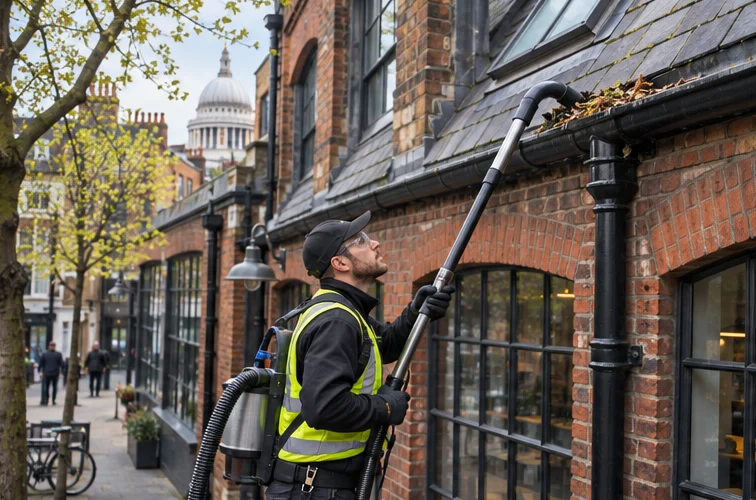
Start at the working position
A gutter can be easy to identify from a street corner and difficult to reach from the ground. On a Clerkenwell enquiry we first ask where we can stand in relation to the roofline. An enclosed courtyard, narrow entrance or awning can prevent a direct approach even when the channel is at a manageable height. Give us the entrance that leads to the affected side, not only the postal address. If that entrance is shared, include the person who controls it and when the route can be used. A photograph that shows the whole elevation helps us see the relationship between the gutter, the pavement and any projection below it.
Islington Council identifies Clerkenwell Green as a conservation area and describes historic layout and mixed building use as features relevant to local character. For a property near the Green, it is useful to explain whether the rainwater system is on the main frontage or in a service yard behind it. We assess the actual building and visible fittings before suggesting any work that could affect their appearance. The local designation helps explain why the address and exact elevation matter. It tells us nothing about whether your particular outlet is accessible.
Access decisions for a shared frontage
| Gutter location | Setup constraint | Useful enquiry detail |
|---|---|---|
| Over a shop door | An occupied threshold limits room below | Door name and available hours |
| Inside a courtyard | Equipment needs a route through the building | Gate and person who opens it |
| Beside an awning | Projection changes the angle for the nozzle | Wide photo including eaves and awning |
How we move debris out of a run
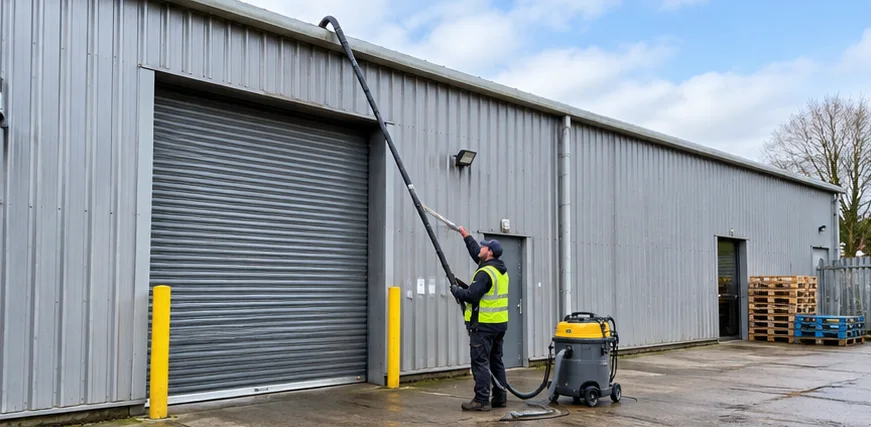
A ground-based vacuum can lift wet leaves, small twigs, moss and silt out of reachable channels. The hose stays below while rigid extension sections carry the nozzle to the roof edge. We need room to direct the head into the gutter and move along the agreed run without using the fascia as a lever. A covered walkway may allow us to set up on one side and prevent us from reaching the other. We look at both ends of the channel before deciding if the run can be cleared from one working position.
A pole-mounted camera can help where a lip or parapet hides the material inside. Its view depends on the angle and the part of the channel that can be reached. We use it to see accessible sections and locate visible debris or fittings. If a short section cannot be approached with the vacuum, we consider manual clearance where direct access is suitable. We explain which sections can be handled on the visit before treating a partial clearance as the whole job.

Vacuum clearance in three stages
1
Working position
Find a usable approach from the pavement or courtyard.
2
Vacuum head
Work through reachable silt and leaves along the run.
3
Hopper
Inspect the opening before water travels down the pipe.
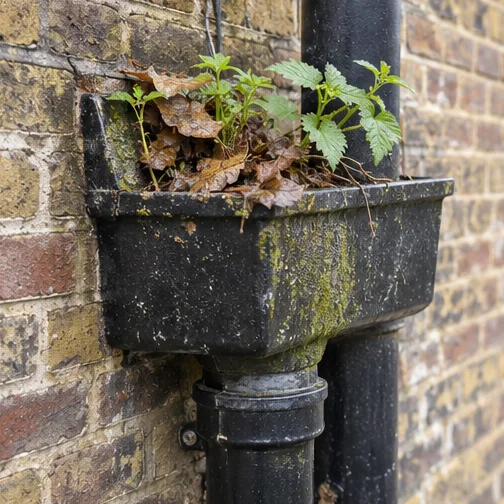
Separate the hopper from the pipe
A hopper can collect water from more than one route. On a rear elevation you might see a short roof outlet discharging into the top and a narrow pipe leaving the bottom. If rain spills from the hopper, we inspect the accessible opening and nearby run to see whether debris is holding water there. Leaves caught at the mouth behave differently from an obstruction lower in the pipe. Tell us if a hopper serves another level or if the only view is from inside the building.
After the accessible debris has been removed, we check whether the outlet can discharge. A gully that is already full below the pipe suggests a problem farther along the drainage route. We explain where the gutter service ends if the water appears to be backing up from a concealed or below-ground connection. A clean channel can still overflow if its discharge has nowhere to go, so the location of the restriction is as useful to establish as the amount of material removed.
Distinguish clearance from repair
| Observed fault | First accessible check | Possible next assessment |
|---|---|---|
| Hopper spills | Debris at the mouth and outlet | Restriction beyond the reachable pipe |
| Drip at a seam | Retained water or fitting movement | Seam still drips after clearance |
| Overflow at a hidden corner | Camera view if the pole can reach | Parapet prevents inspection |
Work above a shared entrance
When an entrance serves shops, offices or residents, find out who can give us access to the section directly below the work. The front door may stay open throughout the day, while a secondary route may be available for part of it. Tell us about deliveries, customers waiting outside and equipment already occupying the route. We discuss the timing and reachable areas with the person who can agree the visit. Where a building has separate occupiers, confirm which section of rainwater system your booking covers.
A converted unit may have a small canopy gutter at street level and a longer run at roof height. They can be independent even when the two outlets are close together. We give them separate names in the enquiry so we can discuss access and the visible symptoms for each. If the high roofline needs a different approach, the lower part can still be assessed on its own terms. For an occupied building, the aim is to leave the site contact with a clear description of what was covered.

Decide what needs repairing
When water drips from one seam, we consider whether the joint itself is defective or whether backed-up water is finding a way out through it. Removing debris near the outlet can change how much water reaches the seam. If the fitting is visibly cracked, shifted or unsupported, we can discuss a repair separately. The condition of the adjacent run matters because a new fitting needs to connect to guttering that can support and drain it. Tell us if someone has already replaced a short section and what changed afterwards.
A mark below the fascia may also come from a higher point where water travelled along a board before it dropped. We ask for the first point where you saw it escape. If the channel is concealed behind a parapet, identify the side of the building and any known outlet rather than assuming the nearest visible pipe is responsible. That information helps define what we can look at and what may need a separate building assessment.
What to put in the enquiry
Give us the full postcode, entrance name or unit number and the part of the roof you want checked. For a rear yard, explain how we get there from the street and whether equipment has to pass through a reception area. If a pipe enters a closed gully, say which parts you can see. Tell us which access times are workable and whether the point of contact can be reached during the visit. Where possible, take a wider photograph from ground level to show the relationship between the gutter and the access route.
If an overflow occurs during trading hours, explain what it affects. Water running onto a door or loading route changes the practical priority even if the rest of the gutter looks dry. We can discuss a first inspection around that area and explain which adjacent parts may also need checking. Keep any previous notes about loose fittings, recurring blockages or a roof section that could not be reached. They help identify whether the same part of the system is causing trouble again.
Access and inspection questions
Can equipment be brought through an occupied reception?
Tell us when the route is available and who can approve it. We need to know about turns, steps and shared doors between reception and the yard, as well as the position from which the gutter might be reached.
Can you clear an outlet behind a parapet?
A pole camera may show the opening if there is a usable angle. We assess whether the equipment can approach the outlet without relying on the parapet. If it cannot be reached, we explain what needs separate access.
What if two pipes discharge into one hopper?
Identify both inlet routes if you can see them. Debris at the hopper mouth or bottom can affect both inlets. A fault farther upstream may affect only one, so mention which route backs up first.
Can I arrange a visit before the shop opens?
Give us the hours when the frontage can be assessed and a contact who can grant access. We can discuss available appointments around opening times and agree which entrances need to remain in use.
What can a camera show near a concealed seam?
A clear angle may reveal a gap or debris close to the seam. The underside and fixings can remain hidden, so the camera view alone does not establish whether a repair is possible.
What information about an earlier repair is useful?
Identify the fitting that changed and what happened in the next rainfall. A replacement section may sit beside the current spill without being its source. Give the location of the earlier repair and the current symptom separately.
Arrange access for a Clerkenwell visit
Include the entrance and the point where water first spills.