
Gutter Cleaning Angel
- Name both streets where a gutter turns the corner
- Distinguish the entrance canopy from the higher roof
- Confirm access with the person responsible for the side elevation

Start where the frontage turns the corner
Islington Council’s design guidelines describe Upper Street and Angel as historic commercial areas, with smaller premises around Camden Passage. If a roofline turns from a busy frontage into a side passage, name both approaches. The entrance used by customers may differ from the route that can be agreed for equipment.
Islington Council’s study of the Angel town centre describes several conservation areas with Georgian and Victorian terraces. The address could be near Upper Street or a different part of the centre. For a booking, the side of the building and its nearest outlet matter more than the area name. Tell us whether you can see the gutter from the street where the door opens, or whether it faces a side street. If the building has a corner entrance, describe which face of the building becomes wet first. Two adjoining roofs can look continuous from the pavement but have separate gutters or outlets.
Where a sign, awning or projecting roof makes it hard to see above the doorway, step back for a wider photo if you can do so safely. Include the nearest pipe and the corner so we can relate the drip to the rest of the roofline. Tell us if the overflow happens only after a long spell of rain or appears as soon as rain starts. A drop that falls from the edge of a canopy might have travelled from higher up. We consider the visible route before deciding whether the first check should be on the gutter above the entrance or on the adjacent section.

Trace a Camden elevation
1
Mark the corner
Relate the spill to both front and side elevations.
2
Confirm the approach
Identify the entrance users and available standing space.
3
Match the outlet
Check which accessible fitting serves the affected return.

Establish who can arrange a position on the right side
The person who reports the water may know exactly which door it falls beside but may not control the area below the roof. Let us know who can confirm where we are allowed to set up. If the public doorway needs to stay available, tell us whether there is a separate side or rear approach. We assess the height and distance to the gutter as well as the ground and any projection beneath it. A canopy or sign can restrict the position even when there is plenty of open space farther from the building.
For a home or flat, tell us whether there is a garden, courtyard or side passage that provides access. If the ground-floor occupier controls the route, give us their details and say who can authorise the work. For a shop or other premises, identify the entrance used for equipment and the time when the working area can be made available. If the booking concerns both the front and side, describe those positions separately. We can discuss what can be reached from each and agree whether both lengths can be included.
Read the signs around a corner roof
| What you see | What we check if reachable | Detail to provide |
|---|---|---|
| Water drops onto a canopy | Gutter and outlet above or beside it | Point where water first hits the canopy |
| Overflow appears on the side street | Return gutter and its connection to the frontage | Which side wets first |
| Pipe seam remains wet after rain | Visible connection and opening above | Position of the seam and prior clearance |
Clear the agreed lengths and look at how they leave the corner
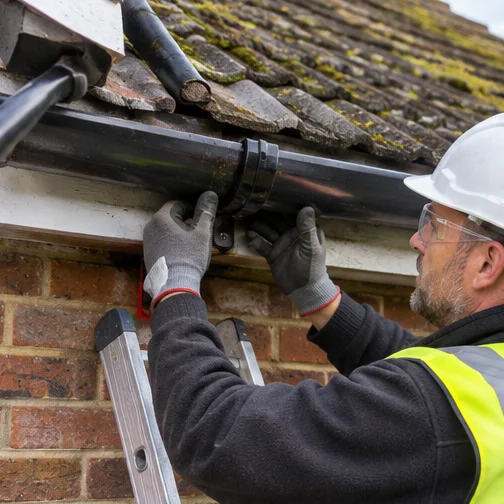
We check the gutter we have agreed to clear and identify where it empties. On suitable runs we use a vacuum and reach poles to collect loose leaves, moss and compacted debris. We work along the accessible channel and pay attention to the corners and the reachable opening into the pipe. If a turn or change in profile sits near the outlet, we look for material held in that part. If the side and frontage gutters meet, we say which part was reached and where the accessible check ended. Read more about the gutter cleaning service for the working position and equipment.
A camera view can help where a roof edge or canopy keeps the channel out of sight. Ask about it before the visit and tell us which part you need to see. The view depends on the available position. It cannot tell us what happens inside a pipe that passes through the building. We can clear a reachable obstruction at the outlet and report it if there is a sign that a restriction may be farther down. If the route turns out to be independent of the gutter you first reported, we explain which fittings were checked and which require a separate assessment.
Separate a recurring drip from the debris we removed
Agree access when entrances have different users
| Position | Contact to confirm | Detail we need |
|---|---|---|
| Shop frontage | Person who can confirm the public route | What must remain open below the run |
| Side entrance to flats | Resident or building contact | Gate, steps and space for equipment |
| Rear yard | Keyholder and person who can agree use | How the yard is reached and when it is available |
Discuss a gutter visit in Angel
Name both streets where a gutter turns the corner
Explain what was cleared using the entrances as reference points
After the work we tell you which accessible runs were cleared and what was checked at the outlets. We use the street, entrance or side of the corner to identify where a visible defect remains. If the working position allowed us to reach the frontage but not the side, we say which length needs separate access. Give us the details of the person who needs the findings if they will not be there. They should be able to identify the fitting from the description without relying on where we stood.
For a later visit, tell us if a new canopy, change to a doorway or different use of the area affects access. If the water first appeared on one side and now shows on the other, describe the new location and what was checked previously. We can use that information to discuss whether it involves the same outlet. If someone has already repaired a fitting since the clearance, tell us where it was and whether the visible symptom changed. We then have a clearer starting point than a repeat request for the whole frontage.

Name the canopy and the roofline separately
Water from a high gutter can strike a canopy even when the canopy itself has a clear outlet. If it drops from the upper edge, show the nearest corner and the point where it lands. If it collects on the canopy before spilling, tell us how the canopy drains and whether its opening is visible. A side entrance used by residents may give a different angle, but we need to know whether it can be opened and who can agree to use it. When a repair is discussed later, refer to the same entrance and fitting so that the occupier and building contact are describing the same part.
Questions about Angel visits
Can you look at the side gutter if the building address is on Upper Street?
Tell us the side street or entrance and which run you mean. We assess the working position there and agree what can be included.
What if the shop below the gutter cannot close its entrance?
Tell us how the entrance is used and whether there is another position. We discuss access before agreeing the work.
Can you tell if the frontage and side share the same pipe?
We check the visible junctions and outlets. If part of the route is hidden, we explain what can be established and what still needs looking at.
Can the tenant who sees the leak give you access?
Yes, where they control the agreed route. If someone else is responsible for the gutter or can authorise a repair, give us that contact too.
Do you clear the canopy as part of the booking?
Tell us if you mean a separate gutter attached to it. We discuss the reachable run and agree the included lengths in advance.
What if the drip is still coming from the same seam?
Tell us where the seam is and what was cleared. We can discuss inspecting the fitting and whether a repair would be a separate visit.