
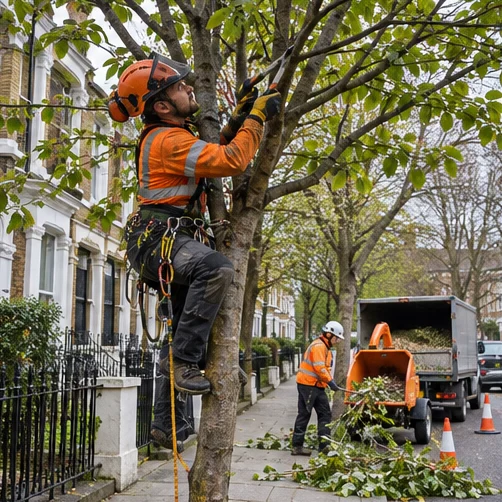
Tree Surgery in London
- Pruning, tree removal and stump enquiries
- Access and surrounding property considered
- Describe the tree, location and work you need
What the booking covers
A tree surgery visit starts with the objective. You may want more clearance from a roof, work on damaged branches or removal of a tree or stump. A broad request to cut a tree back can mean very different work depending on the species, condition and distance from adjoining buildings. Tell us which outcome matters most to you.
Contact us about pruning, tree removal or stump work. Describe the tree and where it sits in relation to roofs, boundaries and access routes. A branch over a gutter is a different enquiry from removing a whole tree. The position of the tree and what is immediately below it help determine what needs assessing.
What we assess and carry out

Branches close to a building
Branches can overhang a roof without touching it, or they can rub against guttering and other fixtures. Tell us which side of the building is affected and whether the branches cross a boundary. We can discuss the clearance needed and assess the branch position relative to glass roofs, extensions, fences and neighbouring property.
Pruning and shaping
Pruning can involve selected branches rather than the same cut all the way round. The age, shape and condition of the tree affect what is suitable. If your objective is to clear a pathway, stop branches touching a roof or address damaged growth, say so at the start. It gives the assessment a practical outcome to work towards.
Removing a tree
The size of the tree is only part of a removal enquiry. Access to the base and room around the tree can influence the work. Tell us about buildings, walls, nearby structures and any restricted route between the tree and the street. Mention if the tree is leaning, partly failed or already damaged, so it can be assessed in context.
Stumps and restricted access
A stump left in a lawn differs from one beside a wall or where a new path is planned. Its width, height and position affect what can be discussed. Explain whether there is a gate, steps or a narrow passage to the site and what you plan to use the space for afterwards. Mention known services or other features near the stump.
Permissions and boundaries
If a tree may be protected, is within a conservation area or sits on a boundary, raise that when you enquire. Check the relevant local authority’s requirements and confirm who can authorise work. Access from an adjoining property may also need to be agreed. We discuss the work that can be considered once the position and constraints are clear.
After storm damage
Explain what has changed, where the damaged material sits and whether it affects a path, entrance or building. Keep clear of unstable branches. If damage involves overhead wires, report it through the appropriate network operator. A description and photos taken from a safe position can help us understand the enquiry before anyone approaches the tree.
What to tell us before we visit
| What you have noticed | What we assess | What to tell us |
|---|---|---|
| Branches near the roof | Discuss which parts need clearance | Point out gutters, glass and neighbouring structures |
| Dead or damaged growth | Assess condition and position before work | Describe when damage was first noticed |
| Whole-tree removal | Review surroundings and access routes | Confirm who can authorise the work |
| Stump left after removal | Discuss its dimensions and position | Explain what the space will be used for |
If you have a photograph, include a wider view that shows the work area in relation to a door, wall or path. A close-up is useful alongside that view. Give us any restrictions that would make it difficult to use the obvious access route, and tell us who can open gates or agree access to shared areas.
From enquiry to completion
Tell us what you need
Describe the tree and where it sits in relation to roofs, boundaries and access routes. A branch over a gutter is a different enquiry from removing a whole tree. The position of the tree and what is immediately below it help determine what needs assessing.
Agree the work and access
We agree which parts of the property the booking covers and discuss how we can reach them. If there is a restricted route, tell us how it works before the appointment. The condition and access on arrival can affect what is practical, so we check the work area before starting. If the work needs a separate assessment, we explain the reason before proceeding.
Review what was found
We explain what has been carried out and tell you about visible faults or restrictions that affect the result. If one part of the property needs a separate visit or another service, we discuss it with you. Keep the location of any outstanding issue in your notes so you can refer to the exact place when you contact us again.

Questions about your visit
Can I ask about one branch over a gutter?
Yes. Tell us which elevation it overhangs and whether it touches the building or crosses a boundary.
Can I book stump work separately?
We can discuss a stump enquiry on its own. Let us know the size, location and route to the site.
What if a tree may be protected?
Check with the relevant local authority before work is arranged. Tell us about any known restrictions and who owns the tree.
Plan the work around your property
When a tree overhangs several properties, start by identifying which branches you are concerned about. A single low branch affecting a path may require a different assessment from a general reduction to the canopy. Confirm who owns the tree and who can authorise access. If there is a shed, fence or greenhouse beneath the canopy, mention that in the enquiry so the surroundings can be assessed with the tree.
Before agreeing a visit, check who will be there, how the working area can be reached and which parts of the building are included. If an access arrangement changes, let us know before the appointment.
If you are booking for someone else, give us the full property address and a contact who can make decisions about access on the day. For a shared building, identify the affected section and who can authorise work there. Let us know if opening times, deliveries or access through a neighbour’s property will affect when we can reach it.
If the enquiry also involves the rainwater system, see our gutter cleaning in london service for the work that can be considered separately.
Decisions we can help you make
Separate the tree issue from the gutter issue
Leaves collecting beneath a tree can justify checking the gutters. It does not automatically establish which branches should be cut or whether pruning is appropriate. If you see a branch touching a tile, pipe or gutter, explain exactly where contact occurs. If the problem is simply a recurring build-up of debris, ask about clearance as a separate visit. This gives each part of the enquiry a clear objective.
Plan the access discussion around the whole garden
Tell us where the tree stands and how someone reaches its base. A narrow passage, steps or a route across another property can affect access even when the tree itself looks easy to reach. Also describe fixed items around it, such as sheds, glass structures and planted beds. If a different person owns or manages the land, find out who can agree the visit and what access that person can authorise.
Arrange your visit
Share your postcode, what you have noticed and which part of the property we need to reach. We’ll discuss what can be assessed on the visit and the available times.