
Gutter Cleaning Isleworth
- Show where the channel disappears behind the roof edge
- Identify the accessible opening nearest the visible spill
- Confirm who can arrange a working position on the rear side

Identify a gutter that is hard to see from below
Hounslow Council’s Isleworth Riverside appraisal describes a historic core with buildings of different ages and narrow residential streets. The roofline still needs to be assessed property by property. An older frontage may conceal a channel that is obvious only from one side. A newer addition behind it may have a short exposed gutter and a downpipe of its own.
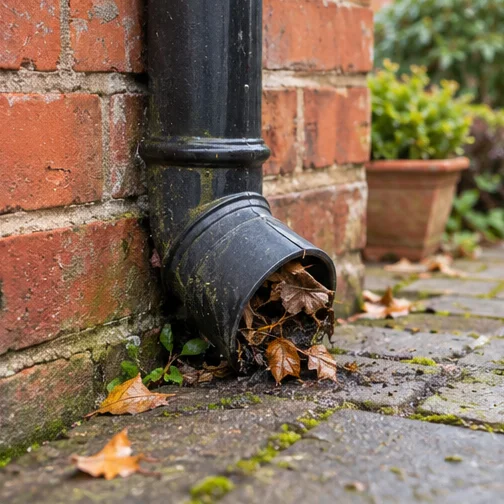
If the outlet is more visible than the gutter, tell us what it looks like and where it sits. A rainwater hopper on the wall may receive water from a short outlet through a parapet or from another pipe above. A photograph showing the hopper and the part of the roof nearest it helps us understand the connection. If water spills from the top of a fitting during rain, tell us how it begins and whether any other gutter spills at the same time.
Where you see staining below an apparently solid edge, describe whether fresh water appears at a seam, from the mouth of an outlet or from behind the gutter. It can travel along a surface before dropping. A photograph after the rain may show the lowest wet point without showing where the water came out. The route matters when we decide what can be checked as part of clearing the channel.
Hounslow lists a distinct conservation area appraisal for Isleworth Riverside. For a property in or near the riverside area, describe the actual elevation rather than assuming that the side facing water is the side that drains there. A rear door or yard reference lets us relate the concealed roof edge to the available approach. Any change to a fitting is a separate discussion after looking at what is visible.

Trace a Camden elevation
1
Sign you noticed
Show where the channel disappears behind the roof edge.
2
What to show us
Identify the accessible opening nearest the visible spill.
3
Detail that helps
Confirm who can arrange a working position on the rear side.
Give us an approach to the opening rather than a view of the wall alone
For a narrow frontage, explain where there is enough ground to stand back from the wall. A short setback or a recess by an entrance may show more of the outlet than the point immediately beneath it. Tell us about steps or railings, particularly where they leave only a narrow path. We look for a suitable ground position before agreeing to include a concealed length.
If you are booking for a rear extension, show us the line from the garden to the higher roof edge. A lower roof can affect reach even where the path itself is clear. When access is through a house or a shared gate, give us the name of the person who can let us in and any relevant details about the route. If you can approach the gutter from more than one side, show both positions so we can discuss the useful one.
For a property beside a path used by others, explain who is responsible for the space directly below the channel. A side route may be available but still need to remain passable. Tell us if the working position is in a courtyard, behind a locked gate or on ground controlled by someone else. We can discuss the arrangements before promising to reach the channel.
Identify a concealed roofline symptom
| Sign you noticed | Check where reachable | Detail that helps |
|---|---|---|
| Water spills at a hopper | Mouth of the outlet and visible build-up | Photo showing what feeds the hopper |
| Stain below a parapet | Accessible channel and nearby visible connection | Point where fresh water emerges |
| Rear extension gutter stays clear but water falls onto it | Reachable channel above and route of the discharge | View showing both roof levels |
Use a vacuum and inspect where the layout allows
Where there is suitable reach, we use a gutter vacuum with reach poles to clear accessible leaves, moss and silt from the agreed sections. Material in a concealed run may not be visible from the pavement. We work towards the reachable outlet and pay attention to the points where the channel turns or narrows. A small opening can hold compacted material even after the rest of a length appears clear.
Ask about a camera check if you want us to look into the channel where it is screened by the roof edge. The available position and angle determine what the camera can show. It may help to see an accessible outlet, but it does not provide a complete view inside an enclosed pipe. Where the opening is reachable, we remove the obstruction we can access and tell you if another part needs investigating.
When we finish, we identify the lengths cleared and the openings we could check. If a concealed section could not be reached, we describe which one and why. A clear outlet does not mean that every part beyond it is clear. See what our gutter cleaning visit includes for how we agree the work and report the accessible findings.

Identify when the channel itself is the problem
A parapet may prevent us seeing most of the channel from below while leaving the outlet or hopper in view. Tell us where water first appears in relation to that visible connection. A roof plan may show the direction of the run, but the visit still depends on a usable ground position and a clear enough angle for the pole. We can assess reachable material and describe which parts the camera can show. If the channel continues behind the wall and the obstruction appears to be farther along, we identify the boundary of the accessible work. For a property contact, a photograph labelled by door and roof level is more useful than a close crop with no reference to the elevation.
Discuss access to a hidden channel
| Property arrangement | What to show us | Decision it informs |
|---|---|---|
| Narrow frontage with railings | Ground available outside the railings and at the entrance | Where the equipment can stand |
| Channel behind a higher roof edge | View from an angle and nearest outlet | What can be seen or reached |
| Courtyard with a locked approach | Route from the gate and person who opens it | How to get equipment to the elevation |
Discuss a gutter visit in Isleworth
Show where the channel disappears behind the roof edge
Record the inaccessible sections as precisely as the completed ones
For a house with several rooflines, name the part you want checked by its position. A note such as “channel behind the rear parapet, above the extension” distinguishes it from the exposed gutter at the end of the extension itself. If an outlet on the wall serves more than one length, say what you know about those connections. Do not assume the two are linked if you cannot see where they join.
When booking for an owner or manager, ask how they identify the affected elevation in their records. If a caretaker can show the access but the owner receives the findings, send us the details for each. We explain the sections cleared and can discuss an alternative approach where the original position did not give enough reach. That allows a later visit to be planned around a specific length rather than repeating an enquiry for the whole roof.

Locate the point where the hidden run becomes visible
If water still escapes at an accessible seam after debris has been removed, we can discuss repairing the affected gutter fitting where a defect can be identified. If the visible surface of a concealed channel appears damaged, record the part that could be seen and discuss whether separate fitting work or further investigation is appropriate. The condition of the channel, support and outlet affects what can be proposed. Where a longer section has failed, we can discuss renewal and how it would meet any retained parts.
Questions about Isleworth visits
Can you clear a channel behind a parapet from the ground?
It depends on its depth, the height and available position. Send a wider view so we can discuss reach and possible access.
What if I can only see the hopper?
Tell us where water appears relative to it. We check the reachable opening and explain what can be seen of its connection.
Does a camera check include the full downpipe?
We can discuss a view of the reachable channel or opening. A concealed pipe may require separate assessment beyond what the camera can show.
Can you arrange the rear access with a caretaker?
Yes. Provide their contact details and identify the relevant gate or entrance. Tell us who can approve any separate work if needed.
What if the wet patch is below an apparently clear gutter?
Describe where water first appears in rain. A visible defect or concealed restriction may remain even where the edge looks clear.
Can you clear a short gutter over an addition at the same time?
Tell us where it drains and what ground is available. We discuss including it as a separate run if it can be reached.