
Gutter Cleaning Leytonstone
- Name the projection below the gutter
- Describe where the pipe becomes visible
- Give the entrance used to approach the affected side
Find where the gutter actually ends
Two lengths can sit close together without being connected. Tell us if you can see a cap, gap or joint between them and where the pipe is in relation to that point. A photograph of both roofs from ground level can show the relationship more clearly than a picture taken directly under the leak. If water first appears at the end of the gutter, describe whether it falls over the edge or drips from the fitting itself. A blocked outlet can cause water to collect toward the far end. Tell us whether the spill begins near the cap or farther along the channel and whether it happens in light rain. We check accessible debris and visible connections before deciding what might need attention. If an older piece was recently replaced, tell us which section stayed in place and whether the problem changed afterwards.
Waltham Forest describes High Road Leytonstone as both a commercial centre and a place where residents live. If an upper occupier reports water that falls near a shop, give both the viewing position and the ground-level access contact. A property away from the high road may instead need a view of the side path or rear addition.

Trace a Camden elevation
1
Read the outline
Identify the upper edge and any bay or canopy below it.
2
Follow the visible pipe
Show its connection and where the discharge can be seen.
3
Agree access
Confirm whose entrance or side ground is needed.

Check the working ground on the included side
The position below the cap may be beside a shared path, a front bay or an enclosed side return. Tell us where the available ground ends and who can open any gate we need to use. The best view may be from one end of the building while the suitable working position is on another side. We discuss where equipment can stand and how it can reach the agreed gutter. If the rooflines are close to the boundary, tell us which parts can be approached from the booked property. We do not assume that we can use an adjoining route or include another length. Where access depends on a neighbour or a resident in another flat, give us the contact who can agree it. If a lower roof or canopy obstructs one side, show the clear ground nearby and how far the roof projects.
Locate water around the stop end
| What you notice | What to show | First check |
|---|---|---|
| Drip begins at the cap | Position of the seam and adjacent support | Visible fitting after clearance |
| Separate gutter sits beside the cap | Both roof edges and pipes if visible | Whether the lengths are connected |
Work towards the end fitting and accessible outlet
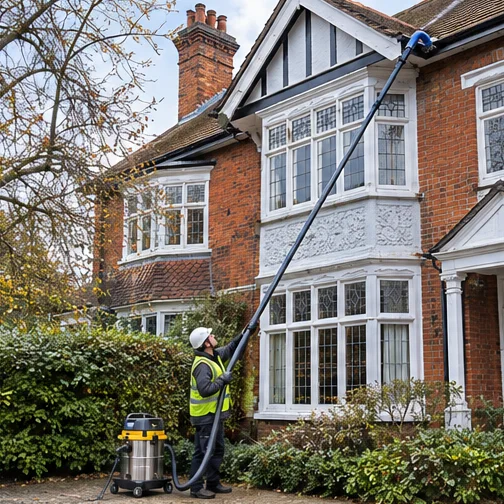
Where the reach and working position suit the equipment, we use gutter vacuum poles to collect leaves, moss and compacted material. We follow the agreed length and look at corners, outlet openings and the material that can collect against a stop end. A gutter can look clear at the edge while debris remains farther back. We work along the accessible channel and describe which sections were reached. At a reachable downpipe opening we remove what we can and explain what is visible of the connection. If a restriction appears to be farther into a pipe, we discuss separate investigation. Ask about a camera check if the cap or joint cannot be seen from below. We consider what angle is available and whether the view would identify the section you reported.

Discussing which sections to include
The booking can cover routine clearance even if only one corner has shown a problem. List the side and rear runs you would like considered, alongside any short gutter over a porch. Say if an extension divides the rear roof edge into separate levels, or if a garage blocks the route from front to back. Each working position needs to be considered on its own. Where a passage belongs to another occupier or there is a locked door into a communal garden, confirm who can let us in. Give both access contacts if different people control the two sides.
Agree access close to a neighbouring roof
| Ground below | Useful detail | What we consider |
|---|---|---|
| Low projection near the boundary | Distance from clear ground to the wall | Reach to the end fitting |
| Garden beside another property | Which side can be opened | Whether another working position is needed |
Discuss a gutter visit in Leytonstone
Name the projection below the gutter
Describe the end that was reached and what still needs attention
After the visit we explain which lengths and openings were checked and where we removed material. If there is a visible issue close to the boundary, we describe the affected side and say where our reach ended. That helps whoever arranges follow-up distinguish the booked end fitting from another gutter beside it. Tell us who should receive the findings if they were not there. For a Leytonstone quote, send the postcode, gutter height and a wider view showing the stop end and nearest visible pipe. Tell us if the run shares an outlet or merely ends beside another channel. If an earlier visit cleared a different side, mention where it stopped. If the leak began after work on the gutter, say which part was changed and whether a new fitting was installed at the end. When the two roof edges are difficult to distinguish, give us a point of reference on each elevation. A window, door or projection can help us identify the same position from the ground. If you can only see the outlet from a garden, tell us who can open it. We can discuss how that route affects which lengths can be reached and whether the neighbouring side would need separate arrangements.

Prepare the roof and access details for Leytonstone
If a bay or canopy becomes wet before the wall below it, show that sequence in the report. Water reaching the lower roof can still originate at the main eaves. The lower outlet may be a separate check rather than proof of the upper fault. If there is a visible pipe behind an extension, give the position of its first exposed fitting and the last place the water can be seen.
A shared route can serve several doors without giving access to every roof above them. Ask which resident, manager or business can open the side that corresponds to your enquiry. Give the person who will meet us the same photograph as the person authorising the work. It is easier to describe a partial result if both contacts use the same roof and outlet references.
Questions about Leytonstone visits
Can you identify which fitting drips if the gutter is dry during the appointment?
A dry camera view can show visible gaps, debris or movement. Tell us what happened in rain, and provide any photographs that identify the corner. We can then relate the visible findings to the part you describe.
Does the bay roof need to be cleared as a separate section?
If it has its own gutter, include it when you describe the property. Say whether the main gutter empties into the bay gutter or whether each has a separate outlet. That detail helps us understand the number of runs to discuss.
Will the visit cover a gutter that crosses the boundary?
Tell us how the gutter is shared and which side is affected. If access or permission is needed from another owner, arrange that before the visit. We can discuss what is reachable once both working areas have been identified.
The drip starts on the inside of the corner. Is that likely to be an outlet blockage?
It could be an issue at the corner, or water may be backing up from farther along. Note which side spills first and whether the pipe appears to receive any water. We can discuss where to begin the accessible camera check.
What if a parked vehicle occupies the only space beneath the bay?
Tell us before you book and explain whether there is another clear working position. If the vehicle can be moved with permission, agree who will move it and when. The working angle needs to be considered as well as the available space.
Can a manager request a camera view for the owner after clearance?
Mention that requirement at booking. Identify the corner or outlet the owner needs to see and who should receive the result. We can discuss the accessible camera view before deciding whether a separate camera inspection is needed.