

How to keep gutters flowing throughout the year
- Plan around the building, not just the calendar
- Consider branches and seasonal debris together
- What collects in the channel
A simple annual log
Build a maintenance routine around the roof, nearby trees and the places where water has previously escaped.
Use one line for each elevation. Note the month, the last notable rain, any overhanging trees and the point at which water escaped. Add a separate line for a porch or extension that discharges independently. Over time the log shows which runs can be checked together and which deserve a different schedule. It is especially useful when maintenance is handed over between occupants.
What to look for
Plan around the building, not just the calendar
Roof pitch, nearby trees and the amount of moss on the tiles all affect how quickly material accumulates. Two buildings on the same road may therefore need different intervals. A gutter below a deciduous tree may collect most of its leaves over a few weeks, while one below a mossy roof can receive debris after successive wet spells. Note when the gutter last overflowed and what was happening around the property at the time. That record is a better starting point for a maintenance interval than assuming every roofline needs the same visit at the same time of year.
Consider branches and seasonal debris together
Overhanging branches can drop material into a gutter, cast shade over paths and sometimes touch the roofline. These effects call for different responses. Clearing a gutter restores an open route for water, while work on a branch changes how it interacts with the building. An overhanging branch should be assessed in its setting, particularly near a boundary, a glass roof or other property. Do not assume the tree needs heavy pruning just because leaves are collecting below it. Describe which branches cause concern and check who can authorise any work before arranging it.
What collects in the channel
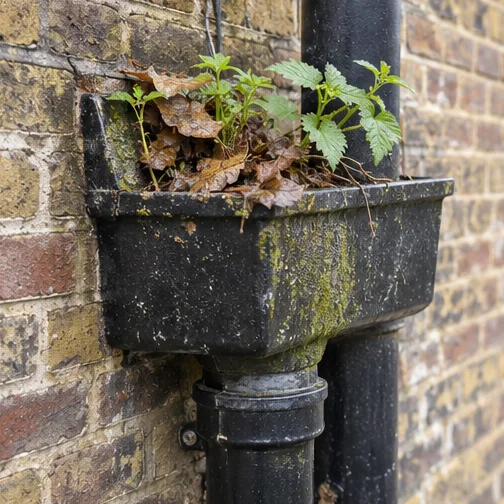
The gutter is a shallow channel, so a small amount of debris in the wrong place can matter more than a thick layer elsewhere. Wet leaves can bridge an outlet while finer material settles under them. Moss from a roof can break into smaller pieces and travel as far as a corner or a bend. From ground level a gutter may appear clear because the obstruction is below its lip. Look for water escaping before it reaches the outlet or for debris showing at a corner. Those clues help identify which run should be inspected, especially if the house has separate front and rear systems.
Build the calendar from observed leaf fall
Choose an inspection point that matches your roof. A gutter below a tree that holds its leaves late into autumn may need checking after that drop, while moss from the roof can arrive at other times. If a run stayed clear through several wet spells last year, record that too. Compare similar conditions from one year to the next before changing the schedule for the whole building.
A practical check before booking
Plan around the building, not just the calendar
Start with the first visible sign and note where on the property it appears.
A simple annual log
Use the example above to decide what details are worth recording for your own property.
Choose the next assessment
Use the table to decide what to describe when you speak to the relevant service.
| Observe | Record | Discuss |
|---|---|---|
| Position | The elevation, surface or part of the system affected | Which area needs assessment first |
| Timing | When the problem appears and what makes it worse | What can be checked during a visit |
| Access | How the area can be reached and who can open it | Which parts are accessible and what may need separate work |
The outlet is a separate checkpoint
The outlet is where the open gutter connects to the downpipe. A blockage there can make the channel fill even when most of the run is free of leaves. The visible sign can be a concentrated spill at the corner or a hopper that fills without discharging. The point that overflows is useful to report, but the obstruction might sit slightly upstream or within an accessible bend. If a pipe joins a water butt, note the position of its diverter. It helps to distinguish the parts of the system that are visible from sections that disappear behind a wall or beneath the ground.
Use a wet-weather observation and a dry-weather check
Heavy rain shows how the system behaves under load. Once conditions settle, a second look from the ground can reveal the position of brackets, staining, slipped fittings or debris visible over the edge. These two observations answer different questions. The wet view shows where water travels; the dry view may show how the gutter is assembled and which part deserves attention. A short video from ground level can be particularly useful when the spill disappears before a visit. Include a wider view so the corner, downpipe and affected wall can be identified later.
Overflow and a leaking joint leave different clues
Water spilling over a broad stretch during a downpour often suggests the channel has filled or the run cannot discharge as quickly as it receives water. A concentrated drip from a fitting can suggest a different issue, especially if it continues after the heaviest rain has passed. Neither sign is conclusive on its own. A blocked outlet can hold water against a weak joint and make both symptoms appear together. Record where the water first leaves the gutter and whether it emerges from the edge, a seam or behind the fascia. That observation is more useful than the location of the puddle below.
Look at how the roofline can be reached
Properties with similar roof heights can require different access. An unobstructed front elevation may be approachable from ground level, while a rear run of the same house sits above a glass roof or beyond a shared passage. A pole needs space at its base and a usable angle to the gutter. A path along the side of a building may be too narrow for one part of the run even when there is room elsewhere. If you are booking a visit, explain how to reach the back, whether there are gates or steps, and what sits directly below the affected gutter.
Plan what happens next
Follow the downpipe to ground level
Rainwater has another journey after leaving the roof. Some pipes terminate above an open gully, while others feed a water butt or go directly into a drain. A gully that is already full can make a downpipe problem look like a roofline blockage. Paving that slopes towards a doorway can also carry water from another part of the property. From a safe position, note whether water backs up at ground level, escapes from a pipe connection or never reaches the outlet at all. These are different observations, and a gutter visit may not resolve a problem downstream of the rainwater pipe.
Agree responsibilities in shared buildings
In a converted house or apartment building, the person who sees a leak may not be the person who can approve roofline work. Identify the property manager or other responsible contact and share the location of the problem. A photograph labelled with the entrance, elevation or flat position makes it easier to distinguish common guttering from a small separate run. Agree who can open gates, contact residents or explain where a vehicle can stop. These arrangements matter for the visit even when the obstruction itself turns out to be easy to clear.
Keep a useful record after the visit
It helps to record which sections were cleared, which outlets were checked and where there was an access restriction. The next time you see a spill, compare its location with that record. A different elevation may be an independent problem, while the same corner repeatedly overflowing can point to a recurring source of debris or a visible defect worth discussing. For a shared building, keep the notes where the next person responsible for booking can find them. A short record with a date, elevation and observation is often more useful than a vague entry that says the gutter was cleaned.
Keep notes useful after an ownership change
Identify each run by a permanent feature such as the front bay or back door. Names such as “left side” can be confusing when people look from different directions. Record the location of any outlet that could not be reached and the access arrangement used at the time. A managing agent or future owner can use that record without having to reconstruct the visit from an invoice.