
How to spot gutter problems before they affect your home
- Use a wet-weather observation and a dry-weather check
- Overflow and a leaking joint leave different clues
- Look beyond the stain
What the first two minutes of a downpour can tell you
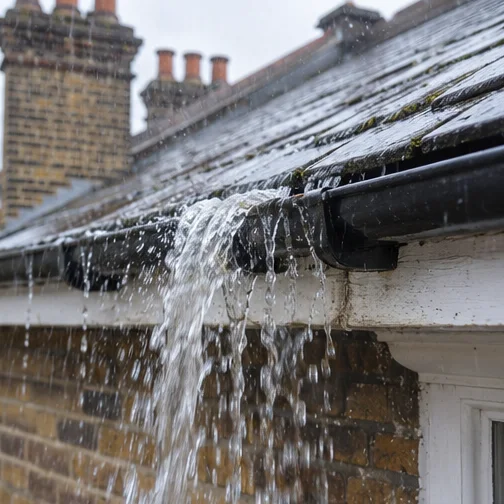
Use the position and timing of a spill to decide which part of the rainwater system deserves attention first.
If a pipe joint drips as soon as water reaches it, record that detail. If the gutter only spills after the rain has continued for several minutes, the run may be filling gradually. Note how long it takes for the spill to stop once conditions ease. Those timings do not prove the cause, but they help someone assessing the roofline decide where to begin.
What to look for
Use a wet-weather observation and a dry-weather check
Heavy rain shows how the system behaves under load. Once conditions settle, a second look from the ground can reveal the position of brackets, staining, slipped fittings or debris visible over the edge. These two observations answer different questions. The wet view shows where water travels; the dry view may show how the gutter is assembled and which part deserves attention. A short video from ground level can be particularly useful when the spill disappears before a visit. Include a wider view so the corner, downpipe and affected wall can be identified later.
Overflow and a leaking joint leave different clues
Water spilling over a broad stretch during a downpour often suggests the channel has filled or the run cannot discharge as quickly as it receives water. A concentrated drip from a fitting can suggest a different issue, especially if it continues after the heaviest rain has passed. Neither sign is conclusive on its own. A blocked outlet can hold water against a weak joint and make both symptoms appear together. Record where the water first leaves the gutter and whether it emerges from the edge, a seam or behind the fascia. That observation is more useful than the location of the puddle below.
Look beyond the stain
A dark patch beneath a gutter deserves attention, but it does not prove that the gutter caused it. Rain can travel along a board, across a sill or down a joint before showing on a wall. Marks left by a past overflow may also remain after the water stops. Compare what happens during rain with what you can see when the wall is dry. If water is entering the building or the affected area grows, describe both the indoor and outdoor signs. The roof, wall and drainage connections may each need to be considered if the accessible gutters are clear.
Look for changes as the rain eases
If a spill stops as soon as the rain lets up, compare that with a joint that continues to drip. The two behaviours can help narrow down which section needs looking at. Take care not to assume that a delayed drip comes from a separate fault. Water can remain in a full run, and a slow release may continue while the rain is already lighter.
A practical check before booking
Use a wet-weather observation and a dry-weather check
Start with the first visible sign and note where on the property it appears.
What the first two minutes of a downpour can tell you
Use the example above to decide what details are worth recording for your own property.
Choose the next assessment
Use the table to decide what to describe when you speak to the relevant service.
| Observe | Record | Discuss |
|---|---|---|
| Position | The elevation, surface or part of the system affected | Which area needs assessment first |
| Timing | When the problem appears and what makes it worse | What can be checked during a visit |
| Access | How the area can be reached and who can open it | Which parts are accessible and what may need separate work |
Follow the downpipe to ground level
Rainwater has another journey after leaving the roof. Some pipes terminate above an open gully, while others feed a water butt or go directly into a drain. A gully that is already full can make a downpipe problem look like a roofline blockage. Paving that slopes towards a doorway can also carry water from another part of the property. From a safe position, note whether water backs up at ground level, escapes from a pipe connection or never reaches the outlet at all. These are different observations, and a gutter visit may not resolve a problem downstream of the rainwater pipe.
What collects in the channel
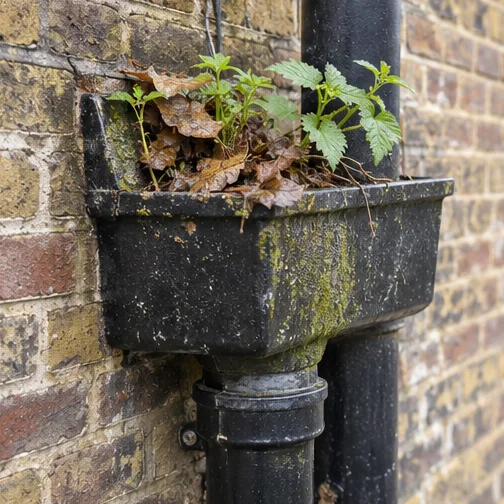
The gutter is a shallow channel, so a small amount of debris in the wrong place can matter more than a thick layer elsewhere. Wet leaves can bridge an outlet while finer material settles under them. Moss from a roof can break into smaller pieces and travel as far as a corner or a bend. From ground level a gutter may appear clear because the obstruction is below its lip. Look for water escaping before it reaches the outlet or for debris showing at a corner. Those clues help identify which run should be inspected, especially if the house has separate front and rear systems.
Identify every independent run
A house with a bay, porch and rear extension may have four short gutter runs as well as its main channels. The small runs may connect to the main downpipe, or they may discharge separately. One clean-looking roofline does not tell you what is happening on the lower levels. Use landmarks such as the kitchen door, bay or shared passage when you describe the building. If a converted property has a common rainwater system, find out which runs are shared and who can agree access. That makes it easier to describe which gutter is causing the problem and which work belongs in a booking.
Look at how the roofline can be reached
Properties with similar roof heights can require different access. An unobstructed front elevation may be approachable from ground level, while a rear run of the same house sits above a glass roof or beyond a shared passage. A pole needs space at its base and a usable angle to the gutter. A path along the side of a building may be too narrow for one part of the run even when there is room elsewhere. If you are booking a visit, explain how to reach the back, whether there are gates or steps, and what sits directly below the affected gutter.
Plan what happens next
Agree responsibilities in shared buildings
In a converted house or apartment building, the person who sees a leak may not be the person who can approve roofline work. Identify the property manager or other responsible contact and share the location of the problem. A photograph labelled with the entrance, elevation or flat position makes it easier to distinguish common guttering from a small separate run. Agree who can open gates, contact residents or explain where a vehicle can stop. These arrangements matter for the visit even when the obstruction itself turns out to be easy to clear.
When to ask for a closer assessment
Water entering the building, a loose fitting above a walkway or a repeated overflow after clearance calls for a closer look. Give the clearest description you can from ground level. A loose pipe, damaged bracket or defective roof covering is not solved by removing leaves alone. Conversely, replacing a fitting will not resolve a blocked outlet further along the run. A useful assessment connects the symptom to an accessible part of the system, explains what was found and identifies where further work might be needed. Keep away from unstable fittings and leave work at height to people equipped to assess access.
Make the first enquiry specific
Give the full postcode, property type and affected elevation. For gutters, say whether the problem is at a joint, outlet, hopper or the wall below. For exterior work, describe the material or tree and mention access restrictions. A wider photo from a safe position is useful because it shows where the work sits in relation to doors, gates and paths. A close-up alone may not show the height or approach. For shared premises, include the person who can agree access and identify the section to be worked on. Avoid assuming that all parts of a property will be included by default.
Use marks as supporting evidence
A line of dirt under the gutter can show where water has travelled before. It may sit below a different section from the one you saw spilling today. Note the start and end of the stain, take a wider view of the roofline and report what you saw in the latest rain separately. That keeps earlier damage from being confused with the active fault.