
Gutter Cleaning Streatham
- Identify the street and affected elevation separately
- Show steps or gates along the agreed route
- Tell us if a lower roof receives water from above
Find the entrance beneath the relevant roof section
Lambeth Council describes Streatham High Road and Streatham Hill as long-established routes with shops, public buildings and residential mansion blocks. Give the affected side and the available entrance rather than assuming the High Road frontage is where we can stand.
Lambeth’s conservation area profile describes Streatham High Road and Streatham Hill as long-established routes with retail and entertainment buildings alongside churches and mansion blocks. At a property along either road, give the nearest fixed entrance, upper window or corner rather than relying on the current business name. One building may have a street-level entrance for customers and a side door for residents. The gutter may continue over both before discharging around a return. A view of the whole frontage shows how the entrances sit in relation to the nearest visible pipe.
If the drops fall from an awning or sign, note where water first reaches the cover. A resident above it may see the outlet or a higher joint, while the person at the threshold sees the last part of the flow. Ask both to give the position and approximate time of the observation. Rain can follow a projecting ledge and become visible some distance from the first wetting. A dry photograph taken from a safe point can still help place each report against the building.

Give us the history of the corner that fills
Knowing the date of the last clearance is useful when the same symptom has returned. Tell us whether water began to escape soon afterwards or only after another period of leaf fall. If you saw material at the outlet, identify the roof edge and where the downpipe connects to it. There may also be a separate lower gutter that receives water from the higher level. Describe where it first spills and how that relates to the upper channel. We use a pole camera to look into accessible sections, then vacuum the material we can reach. We review the cleared length before discussing any visible fault.
A straight length may drain towards a visible downpipe at the corner or continue around the next elevation. If several runs meet there, tell us which one appears to fill first. A view showing the pipe and neighbouring roof edges can help locate the point you mean. Where material has gathered at a turn, the overflow may become visible farther along before you see water at the corner itself. We ask where it first goes over an edge or emerges from a fitting. That distinction helps us discuss a clearance, an inspection or a separate repair at the visible joint.
A narrow side route can be the only way to reach the rear, or there may be a separate gate into the garden. Tell us where it leads and whether there is room to work beneath the affected length. Mention a lower roof, bin store or fixed obstruction. A homeowner can explain what is usually left in the passage. For flats, identify who can open the shared entrance and agree what needs to be moved. At commercial premises, ask the person who manages access when the side route is used for deliveries and whether the equipment can be positioned out of the way.
Moss, leaves or silt may conceal part of the gutter while it is full. After using the vacuum on the accessible length, we check it with a pole camera. This helps us see a visible gap, movement at a connection or a section that still appears to hold water. If the symptom is a drip at one point rather than a wide overflow, tell us where it starts. A photo can show how the fitting sits relative to a window, corner or support. We can then discuss gutter repairs if a defect is visible. Some fittings may be hidden by the angle from below, and we explain what can be checked.

Establish the height and route from the working side
A house on rising ground can have a level front path and steps down to the rear garden. Estimate the height from below the affected length, and show the ground in the same view as the wall if possible. A rear extension, canopy or balcony can occupy the space directly under the gutter. Tell us where the nearest open ground lies and how someone reaches it. If the side path narrows or passes under a roof, include the narrowest point and any turn beyond the gate.
For a business or block, a service yard may provide a route away from the frontage. Confirm who can open the relevant door and when vehicles, deliveries or other residents use that route. A yard can give access to one elevation without reaching another. Where a flat controls a private garden beneath a shared roof, the person instructing the work should confirm who can provide entry and what area has been agreed. The resident who reports the drip may have no access to the ground beneath it.
Streatham roof and outlet observations
| What you see | Detail to send | Why it helps |
|---|---|---|
| Water near a mansion block entrance | Nearest upper window, door and visible pipe | Identifies the affected roof section along a long frontage |
| Drip from a High Road canopy | Where water first reaches the cover | Relates the entrance report to the upper wall |
| Overflow from a rear addition | Whether a higher pipe ends on the lower roof | Shows how the two roof levels may connect |
| Wet paving beside the pipe | Whether the pipe reaches a gully or enters paving | Locates the last visible part of the discharge route |
Follow the visit from street to garden
1
Locate the reported spill
Identify the street and affected elevation separately.
2
Agree the working route
Show steps or gates along the agreed route.
3
Check the remaining details
Tell us if a lower roof receives water from above.
Review fittings that may need attention after clearance
Leaves and sediment can collect near an opening and cause water to stand at a seam elsewhere. Once the reachable material has been removed, a visible drip may still relate to a local gap, displaced support or change in fall. Guttering repairs can be considered against the condition of the affected fitting, the adjacent gutter and its support. If a previous project changed a connector or moved the outlet, give the location and share any record showing where the new piece meets the original run.


Follow the visible pipe to the point where it disappears
A downpipe from the main roof can discharge onto a lower roof or continue down the wall beside it. If the extension or canopy spills, describe where the upper pipe ends and whether there is an outlet on the lower roof. A photograph showing both levels helps locate the connection. Water may travel across the lower surface before it becomes visible at the outer edge. If possible, note whether the first spill appears at the upper gutter, a pipe joint or the lower edge.
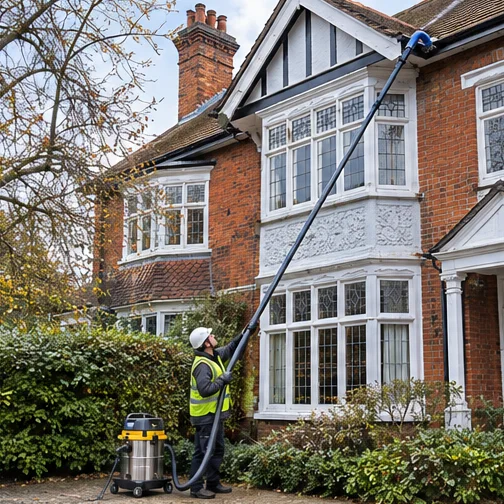
For a Streatham visit, we confirm which channel or outlet can be reached from the entrance on the agreed side. An extendable vacuum may be practical where the working position gives a suitable angle and reach. A camera can sometimes show material around an accessible outlet or bend. At the foot of the pipe, say whether it ends above a gully or passes below paving. Surface runoff may also collect in the same area. An enclosed bend or buried connection may need a separate inspection where its condition cannot be assessed from the visible parts.
Confirming access to the affected wall
| Working area | Practical detail |
|---|---|
| Shop and residential entrances on separate sides | Which door is affected and who controls each route |
| Yard reached through a service gate | Key holder, delivery use and position of any cover |
| Garden below a stepped side path | Ground levels and width at the tightest point |
| Shared roof above a private garden | Who agrees the work and who can provide entry |
Give each later observation a stable location
A clearance record can name the accessible sections reached and describe any visible point requiring further attention. Use a reference such as the outlet beside the stair door or the short gutter above the rear window next to the gate. A shop sign may change while the layout of the wall remains recognisable. A building contact can share the same reference with residents, staff and anyone arranging the next inspection. Confirm who should receive the report and who can arrange a different approach if one section needs it.
At the next rain, note whether water first becomes visible at the original spot and how long it takes to appear. A main spill may have stopped while a lower pipe joint still drips. Record the two positions separately. If an inside mark changes, give the date, room and nearest exterior feature. A dated photograph from the same safe position can help distinguish old staining from fresh wetting. The person arranging follow-up can compare the latest account with the clearance record before deciding which fitting, concealed connection or part of the building to investigate.
Discuss a gutter visit in Streatham
Identify the street and affected elevation separately
Questions about Streatham visits
What if the frontage faces the High Road but the pipe is on the side?
Show both walls and the roof return between them. Tell us where you first see water and which route gives access below the pipe. The front and side may need different working positions.
Can you clear a gutter above a basement entrance?
It depends on the position of the steps, railings and available ground. Send a wide image showing the whole wall and the entrance below. Tell us how that route is used by residents or staff.
Why might a lower roof spill when the upper gutter looks clear?
The lower roof can receive water from an upper pipe and still have a restriction of its own. Show the two roof edges and where the pipe ends. The first point where water becomes visible helps identify which area needs assessment.
Can a service gate provide access while the frontage stays open?
It may provide a suitable route to the rear or side. Confirm who can open it and how the yard is used. A front gutter can still require a separate approach.
Does a visible gap at a seam mean it needs replacement?
A local repair may be possible if the adjoining parts and support are suitable. Share the position of the gap and any previous work at the same point. An assessment can consider the surrounding channel before deciding what to change.
What should residents tell the agent if a drip returns?
Give the first wet point, time and nearest fixed feature. Compare the position with the one named in the clearance record. If a different wall or room is affected, describe that observation separately.